EN
Product Tips
Sep. 24, 2026
Most importers do not buy prestressed concrete strand every week — they buy it a few times a year, in volumes that either keep a precast yard running or stop it cold. The strand you order today is tensioned into slabs, beams, bridges and tanks that must hold load for decades. One bad coil — undersized diameter, missing mill certificate, relaxation above spec — can stall a project and cost far more than the price difference you saved. This guide is written for B2B buyers who want to compare 7-wire strand offers with confidence.
In this guide: the 7 sourcing mistakes that cause field rejections · how to verify a PC strand supplier · six verifiable selling points · an ASTM A416 spec table · a pre-quote checklist · FAQ.
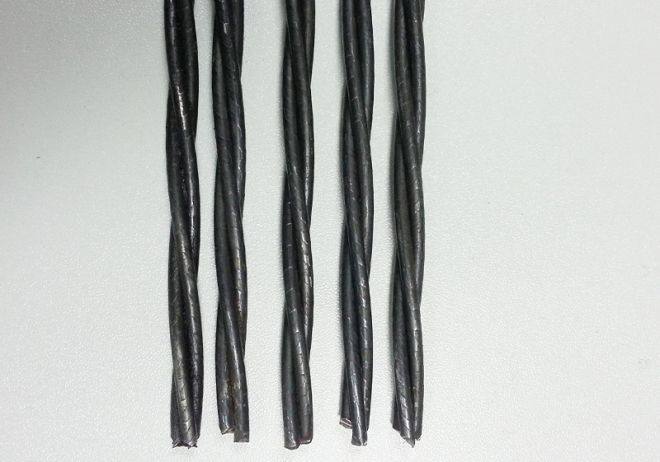
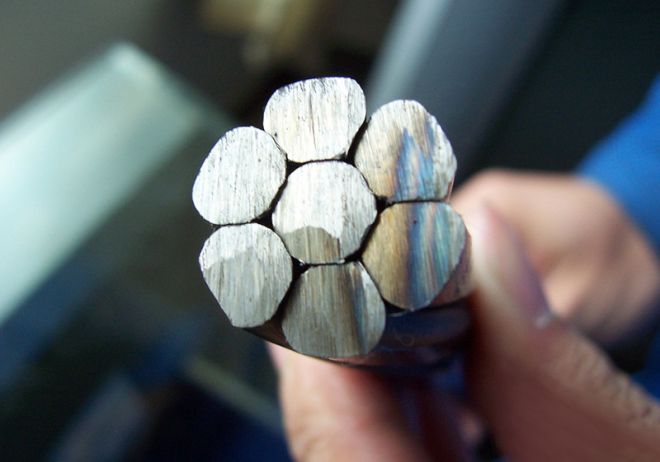
Prestressed concrete strand — PC strand for short — is a 1×7 (7-wire) high-strength steel strand drawn from high-carbon wire rod, stress-relieved and laid in a helix so it can carry a permanent tensile load. It is the working core of prestressed and post-tensioned concrete: the strand is tensioned before or after the concrete hardens, then anchored, so the structure resists bending and cracking far better than conventionally reinforced concrete.
Buyers usually meet two relaxation classes: stress-relieved and low relaxation. Low relaxation strand keeps its tension for decades — relaxation at 1000 hours no more than 2.5% at an initial load of 70% of the nominal maximum load — which is why most structural projects now specify it. If a supplier cannot show relaxation data on the mill certificate, treat the offer as incomplete.
These are the rejection reasons and cost traps we see most often on B2B platforms and in incoming inspections:
Undersized or out-of-round coils
Field inspectors reject strand below the diameter tolerance — for example −0.15 mm on 12.7 mm, or +0.65/−0.15 mm under ASTM A416. Ask for micrometer checks at both ends of every coil.
Surface defects that become corrosion
Scratches and scabs breach the 1% surface-area limit and become corrosion points inside grouted tendons. Demand surface inspection in the third-party report.
No traceable mill certificate (MTC)
Every batch should ship with an MTC listing chemical composition and mechanical test results. No MTC means no traceability — and no claim if something goes wrong later.
Relaxation swapped for stress-relieved
A stress-relieved coil sold at a low-relaxation price is the classic substitution. Confirm "low relaxation ≤ 2.5% at 1000 h" in writing before you pay.
Standards and grades mixed up
ASTM A416 Grade 270, GB/T 5224, pr EN 10138-3 and JIS G3536 use different diameters and breaking loads. Specify the standard your engineer and anchorage supplier accept.
Price above delivery discipline
Steel prices move every week; the real cost of a cheap coil is a delayed shipment that stops your yard. Put the lead time in the contract, not just in the chat.
Hidden costs outside the FOB price
Packaging, documentation, third-party inspection and port demurrage add up quickly. Ask for a full landed-cost breakdown before you compare quotes.
Once you understand the risks, verification is a checklist, not a guess. Run every candidate through these five points:
Standards coverage — does one product line cover ASTM A416, GB/T 5224 and pr EN 10138-3? Multi-standard compliance shortens re-qualification when you ship to different regions.
Documents — an MTC for every batch, CE/SGS/BV reports, and support for third-party inspection before loading.
Factory proof — production history, audits by independent inspection agencies, and real capacity to absorb your order.
Delivery discipline — on-time delivery written into the contract, not promised in a message.
Technical responsiveness — quick, concrete answers on anchorage compatibility, diameters and grades.
Yuanxian High-Tech Material Trading (Tianjin) Co., Ltd. has manufactured prestressed strand since 2007 and exports to more than 50 countries. We publish our spec sheets openly so buyers can verify before they call — see our 1x7 prestressed steel strand product page with full mechanical data.
1. Full size range, factory-direct
1×7 strand from 9.53 to 17.78 mm — 9.5, 11.1, 12.7, 15.2, 15.7 and 17.8 mm — in 1860 MPa and 1960 MPa grades. One supplier covers slab, beam, bridge and tank specifications.
2. Low relaxation by design
Relaxation ≤ 2.5% at 1000 hours, so the prestress you pay for stays in the concrete for the life of the structure.
3. Three standards, one product line
ASTM A416/A416M:2012, GB/T 5224-2014 and pr EN 10138-3:2011, with CE, SGS and BV certification — one re-qualification serves multiple export regions.
4. Traceability you can file
An MTC for every batch, plus optional third-party inspection before shipment — documents your consultant will actually accept.
5. Supply security
Production capacity up to 10,000 tons per month and MOQ from 3 tons, with OEM/ODM customization of surface and certification.
6. Experience since 2007
Used in national key infrastructure projects and exported to Spain, France, Sweden, Ukraine, Peru and beyond.
The table below shows the ASTM A416 Grade 270 (1860 MPa) range — the sizes most global buyers quote. Full tables for GB/T 5224 and pr EN 10138-3 are available on request.
| Nominal diameter (mm / in.) | Section area (mm²) | Weight (kg/1000 m) | Min. breaking load (kN) | Min. load at 1% extension (kN) |
|---|---|---|---|---|
| 9.53 (3/8) | 54.8 | 432 | 102.3 | 92.1 |
| 11.11 (7/16) | 74.2 | 582 | 137.9 | 124.1 |
| 12.7 (1/2) | 98.7 | 775 | 183.7 | 165.3 |
| 15.24 (3/5) | 140 | 1102 | 260.7 | 234.6 |
| 17.78 (7/10) | 189.7 | 1487 | 353.2 | 318 |
Common to all sizes: 1×7 structure, elongation ≥ 3.5%, low relaxation ≤ 2.5% at 1000 h (70% initial load), lay length (12–16)d, diameter tolerance +0.65/−0.15 mm.
Precast concrete plants
Hollow-core slabs, piles and sleepers — uniform strand geometry keeps stressing lines productive.
Bridges and post-tensioning
High-strength 1860 MPa strand spans longer girders with less steel — the classic post-tensioning strand application.
Dams, LNG tanks, nuclear power stations
Low relaxation holds design tension for decades in critical containment structures.
Foundation pit support & geotechnical anchoring
Reliable breaking loads for temporary and permanent earth retention systems.
Diameter and grade (e.g., 12.7 mm or 15.2 mm, 1860 MPa or 1960 MPa).
Governing standard (ASTM A416, GB/T 5224, pr EN 10138-3 or other).
Order quantity — MOQ from 3 tons.
Destination port and country.
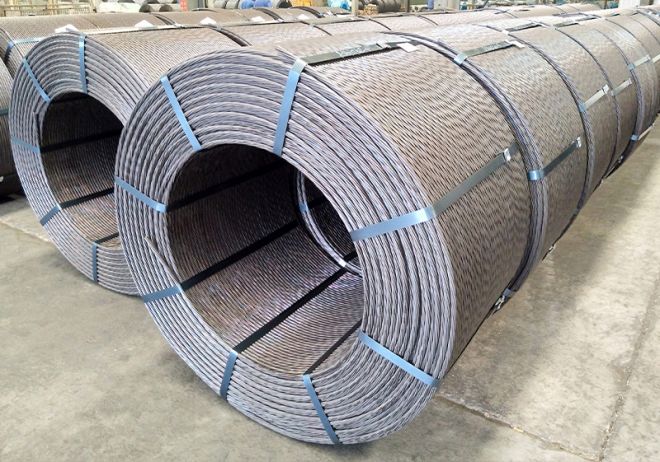
Packaging needs (we ship on steel reels, wrapped in plastic film and woven fabric — seaworthy export packing).
Certification and inspection needs (MTC, CE/SGS/BV, third-party inspection).
With these six points, a factory-direct supplier can quote accurately on the first call — and you can compare PC strand price offers on an equal basis.
PC wire is a single drawn wire; PC strand is seven wires laid helically (1×7) for a higher breaking load and better grip in the anchorage. Strand is the standard tendon for post-tensioning, while wire is common in pre-tensioned lines and stay cables.
Grade 270 is the ASTM A416 strength grade: ultimate strength 270 ksi, equivalent to 1860 MPa. We also supply 1960 MPa strand for higher-load designs.
For structural work, choose low relaxation strand: ≤ 2.5% at 1000 hours keeps prestress over the structure's life. Stress-relieved strand costs less but relaxes more — specify it only when the design permits.
Match the region and your anchorage system: ASTM A416 in the Americas, pr EN 10138-3 in Europe, GB/T 5224 in China, JIS G3536 in Japan. We manufacture one product line covering the first three, which shortens re-qualification across markets.
An MTC for every batch with chemical composition and mechanical results, CE/SGS/BV certificates, and third-party inspection reports on request.
MOQ from 3 tons. Lead time is confirmed in writing at quotation for your port. Production capacity up to 10,000 tons per month keeps schedules stable.
Our Made-in-China listing shows an indicative FOB range of USD 500–600 per ton. Steel prices move weekly, so confirm the current price and freight with your quote.
Yes. Surface treatment and certification documentation can be customized to your contract, and we support third-party inspection before loading.
Tell us your diameter, standard, quantity and destination port — we will reply with a quote, an MTC sample and a realistic lead time.
Call +86 180 2006 1362or request a quote on www.yxmaterial.com
Disclaimer: this article is general sourcing guidance, not an engineering specification. Always verify strand properties against the mill test certificate and the governing standard for your project. © 2026 Yuanxian High-Tech Material Trading (Tianjin) Co., Ltd.
What Are the Benefits of the Aging Period for High-Carbon Steel Wire Rod?
Principle and Function of Hydrogen Embrittlement Test (HE TEST)
HOT PRODUCTS

Yuanxian High-tech Material is a company serving a worldwide customers base providing innovative and reliable product solution that recognizes the value of customer care.
+86 180 2006 1362
Haitai Huake Third Road No.1, Huayuan Industrial Zone, Binhai High Tech Zone, Tianjin, china
Quick Links
Product Category

Request a Quote
Welcome to subscribe toour email message!

Send a Message