EN
Price And Market Trend
Oct. 28, 2026
To specify Prestressed concrete steel wire, I define the product form, nominal diameter, tensile strength, relaxation class, surface condition, applicable standard, permitted tolerances, testing requirements, and documentation. These details connect structural design assumptions with the material delivered to the precast or post-tensioning project.
| Specification field | What to define | Why it matters |
|---|---|---|
| Product form | Individual wire, seven-wire strand, bonded strand, or unbonded strand | Determines anchorage, bonding, installation, and design compatibility |
| Diameter and area | Nominal diameter, steel area, dimensional tolerance, and out-of-roundness | Controls force capacity, fit, mass, and elongation calculations |
| Mechanical properties | Tensile strength, yield or proof stress, breaking load, and elongation | Confirms the wire can achieve the specified prestressing force |
| Durability | Surface condition, corrosion protection, relaxation class, and coating | Reduces corrosion and long-term prestress losses |
| Verification | Mill certificate, tensile test, bend test, relaxation data, and traceability | Creates objective acceptance criteria for procurement and site inspection |
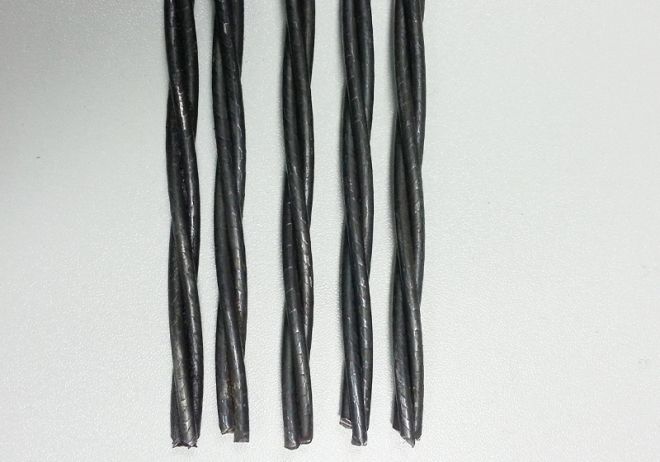
Prestressed concrete steel wire is a high-carbon, cold-drawn steel product used to introduce compressive force into concrete before or after service loads are applied. The wire is tensioned against an anchorage or casting bed, and the transferred force compresses the concrete section. This allows precast beams, sleepers, piles, poles, slabs, bridge girders, and other elements to carry tensile and bending effects with controlled cracking.
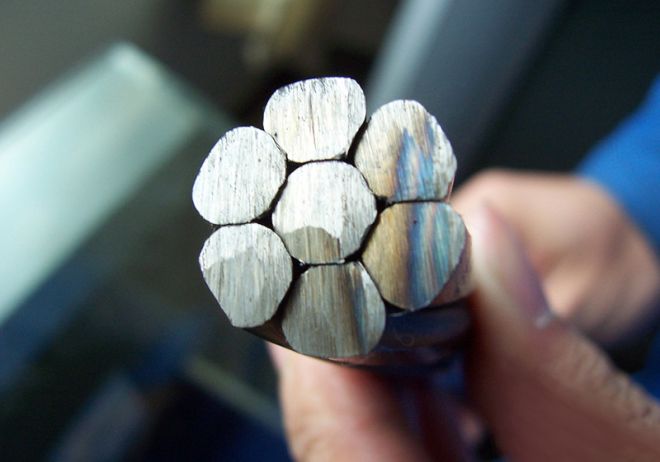
I distinguish individual PC wire from seven-wire PC strand before preparing any purchase specification. Individual wire is a single round or profiled steel element, while seven-wire strand consists of one central wire surrounded by six helically wound wires. ASTM A421 is associated with stress-relieved steel wire for prestressed concrete, whereas ASTM A416 covers low-relaxation and stress-relieved seven-wire strand.
The product form affects the anchorage system, duct arrangement, bond behavior, installation equipment, and design equations. A specification that states only “prestressing steel” is incomplete because it does not identify whether the supplier should provide individual wire, seven-wire strand, bonded strand, or unbonded strand.
I write the specification in the same order that a designer, buyer, manufacturer, and inspector will use it. First, I identify the structural application and prestressing method; second, I define geometry and mechanical properties; third, I state surface, relaxation, testing, packaging, and documentation requirements. This sequence reduces ambiguity in supplier quotations and prevents a product with the wrong form or grade from being accepted.
Identify the component, production method, and applicable design standard.
Select individual wire or strand based on the anchorage and bonding system.
Define nominal diameter, steel area, mass, and dimensional tolerances.
Specify tensile strength, proof stress, breaking load, elongation, and relaxation class.
State surface condition, coating, straightness, joints, packaging, and marking requirements.
Require testing records, heat or coil traceability, inspection certificates, and nonconformance procedures.
Prestressing steel wire diameter selection begins with the required prestressing force, available concrete section, anchorage dimensions, cover, spacing, and crack-control limits. I calculate the required steel area first, then check whether the selected individual wires or strands fit the duct, sheathing, anchor head, and reinforcement layout. The diameter should not be selected only by comparing nominal breaking loads.
For a round wire, the nominal cross-sectional area can be estimated from A = πd²/4, where d is the nominal diameter. The nominal tensile capacity is then related to the steel area and specified ultimate tensile strength, although the certified breaking load remains the acceptance value. For example, increasing diameter from 5 mm to 7 mm increases theoretical area by approximately 96%, so the force capacity, mass, spacing, and anchorage requirements also change substantially.
Common project specifications may identify individual wire sizes such as 3 mm, 4 mm, 5 mm, 7 mm, or 9 mm, but the permitted sizes and mechanical properties depend on the selected standard and manufacturer designation. For strand systems, typical nominal diameters include 12.7 mm and 15.2 mm, with the actual nominal area and breaking load defined by the governing strand standard. I always require the supplier to state nominal diameter and nominal steel area separately.
| Application | Typical specification focus | Primary diameter concern |
|---|---|---|
| Railway sleepers | Indented or profiled wire, bond performance, repeatable cut lengths | Fit within the sleeper reinforcement cage and maintain concrete cover |
| Precast poles | Individual wire or strand, corrosion control, long-line tensioning | Required force per pole and anchorage compatibility |
| Precast slabs and beams | Low-relaxation wire or strand, elongation control, production speed | Steel area within the thin section and transfer-zone detailing |
| Bridge girders | Low-relaxation strand, high breaking load, approved anchorage system | Duct size, tendon grouping, and jack capacity |
| Concrete piles | Indented wire or strand, bond, fatigue, and corrosion resistance | Required prestress and transfer length |
Prestressed steel wire tensile strength is normally stated in megapascals, while the design force is calculated from stress multiplied by steel area. A complete specification should identify ultimate tensile strength, yield strength or proof stress, minimum elongation, minimum breaking load, and the test method. If the standard uses a grade designation such as 1570, 1670, 1770, 1860, or 1960 MPa, I require the supplier to confirm the exact grade definition rather than assuming that the number alone describes every mechanical property.
For seven-wire strand, ASTM A416 includes Grade 250, equivalent to 1725 MPa, and Grade 270, equivalent to 1860 MPa, based on nominal strand area. European and British specifications may use different grade and property tables under EN 10138 or BS 5896. AASHTO project requirements can add transportation-specific acceptance conditions, so the purchasing document should state both the material standard and the project specification.
Ultimate tensile strength determines the upper resistance of the wire, but it does not by itself determine long-term performance. I also specify proof stress, elongation after fracture, relaxation class, and any required stress-relaxation test at the intended initial stress. Low-relaxation products are generally selected when the project requires tighter control of long-term prestress losses.
Stress-relieved wire and low-relaxation wire are not interchangeable descriptions. Stress-relieved products receive thermal treatment to reduce residual stress, while low-relaxation products receive additional controlled treatment intended to limit stress loss under sustained loading. The purchase specification should identify the required class and test duration instead of allowing the supplier to substitute a different treatment without approval.
Prestressing wire dimensional tolerances should cover more than nominal diameter. I include diameter deviation, out-of-roundness, straightness, coil condition, surface profile, length tolerance where cut lengths are supplied, and mass verification. The exact numerical limits must come from the selected standard, approved drawing, or project specification because allowable values differ between individual wire, indented wire, ribbed wire, and seven-wire strand.
| Acceptance item | Requirement to state | Typical verification |
|---|---|---|
| Diameter | Nominal value and upper and lower permitted deviation | Micrometer readings at specified locations |
| Out-of-roundness | Maximum difference between perpendicular diameter readings | Two-axis dimensional measurement |
| Steel area | Nominal area used for design and breaking-load calculation | Certificate review and dimensional calculation |
| Straightness | Maximum deviation over a stated measurement length | Gauge, straightedge, or production-line inspection |
| Surface condition | No harmful scale, laps, cracks, oil, loose rust, or coating defects | Visual inspection and approved surface test |
| Joints | Permitted or prohibited welds, butt joints, and coil connections | Coil inspection and mill documentation |
Indented and ribbed wire requires an additional profile description because indentation depth, spacing, pattern, and damaged ribs affect bond with concrete. Galvanized wire and epoxy-coated wire require coating continuity, thickness, adhesion, and holiday inspection requirements where corrosion protection is part of the design. Plain wire may be appropriate for certain anchorage or prestressing arrangements, but it should not be substituted for profiled wire where bond performance is essential.
I classify the product according to both geometry and protection. Plain wire has a smooth surface, while indented or ribbed wire increases mechanical interlock with concrete. Cold-drawn high-carbon wire provides the base strength level, and thermal treatment determines whether the final product is stress-relieved or low-relaxation.
| Product type | Specification implication | Typical use consideration |
|---|---|---|
| Plain wire | Specify smooth surface and anchorage compatibility | Suitable where bond and anchorage design permit |
| Indented or ribbed wire | Specify profile geometry and bond-related requirements | Common for sleepers, piles, poles, and precast units |
| Stress-relieved wire | State relaxation category and heat-treatment requirements | Used where controlled residual stress is required |
| Low-relaxation wire or strand | State relaxation limit, test stress, duration, and temperature | Preferred for long-term prestress-loss control |
| Galvanized wire | Specify zinc coating mass or thickness, adhesion, and continuity | Used where additional corrosion protection is required |
| Epoxy-coated wire | Specify coating thickness, curing, adhesion, and defect limits | Used where a polymer barrier is approved by the design |
ASTM A421 is commonly used for stress-relieved individual wire, while ASTM A416 addresses uncoated seven-wire strand for prestressed concrete. BS 5896 covers high-tensile prestressing wire and strand in British practice, and EN 10138 divides prestressing steels into product parts covering wire, strand, and related forms. AASHTO requirements may govern bridge and highway projects in the United States and can impose additional testing, certification, or approved-source conditions.
| Reference system | Primary specification role | Buyer action |
|---|---|---|
| ASTM A421 | Stress-relieved steel wire for prestressed concrete | Confirm wire diameter, grade, mechanical properties, and relaxation requirements |
| ASTM A416 | Low-relaxation or stress-relieved seven-wire strand | State strand diameter, grade, nominal area, breaking load, and packaging |
| BS 5896 | Prestressing wire and strand used in British specifications | Use the exact edition and product category in the order |
| EN 10138 | European prestressing steel product requirements | Identify the applicable part and designation for wire or strand |
| AASHTO requirements | Bridge and highway project acceptance conditions | Check agency clauses, approved suppliers, testing, and certification |
I do not treat equivalent standards as automatically interchangeable. When a supplier offers an alternative designation, I compare nominal area, tensile strength, proof stress, elongation, relaxation, dimensional limits, surface condition, and testing methods line by line. The purchase order should identify one governing standard and list any approved supplementary requirements.
Before use, I check coil or reel identification, heat number, production date, product form, nominal diameter, surface condition, packaging damage, and certificate consistency. I then compare the mill certificate with the purchase order, approved drawings, and applicable standard. Material without traceable documentation should be quarantined until the manufacturer or independent laboratory provides acceptable evidence.
Dimensions: Measure diameter, out-of-roundness, profile, length, and straightness where applicable.
Mechanical properties: Verify tensile strength, proof stress, breaking load, elongation, and the number of tests.
Relaxation: Confirm the specified relaxation class, test stress, temperature, duration, and reported percentage loss.
Surface: Reject visible cracks, laps, harmful scale, loose rust, oil contamination, coating holidays, and severe mechanical damage.
Continuity: Confirm whether welds, joints, repaired areas, or coil connections are permitted.
Documentation: Require a certificate of conformity, test report, traceability record, packing list, and nonconformance statement.
For critical bridge, girder, pile, or post-tensioning work, I specify independent verification testing at a defined sampling frequency. The test plan should identify tensile testing, bend testing for wire where applicable, dimensional checks, relaxation testing, coating inspection, and laboratory accreditation requirements. Acceptance should be based on measured results against the stated standard, not on a supplier’s general product brochure.
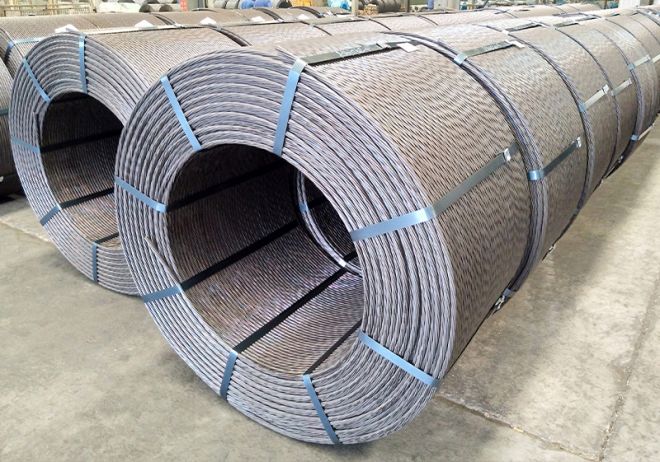
A practical RFQ should give the supplier enough information to quote an equivalent product without guessing. For example, I might request indented low-relaxation prestressing wire for precast concrete piles, with a nominal diameter of 7 mm, a specified strength grade, defined minimum breaking load, minimum elongation, dimensional tolerance, surface condition, coil mass, delivery length, and certificate requirements. If the project uses strand instead, I would identify seven-wire strand, nominal diameter, grade, nominal area, anchorage system, and whether the strand is bonded or unbonded.
| RFQ field | Example information to provide |
|---|---|
| Material | Cold-drawn, indented, low-relaxation prestressing steel wire |
| Application | Precast concrete piles or sleepers |
| Size | 7 mm nominal diameter; supplier to state nominal area and mass |
| Strength | Specified grade and minimum tensile strength in MPa |
| Tolerance | Standard diameter deviation, out-of-roundness, profile, and straightness limits |
| Testing | Tensile, elongation, bend where applicable, relaxation, and dimensional tests |
| Standard | Governing ASTM, BS, EN, AASHTO, or project-specific requirement |
| Documents | Mill certificate, test report, traceability, packing list, and certificate of conformity |
| Commercial terms | Price per metric ton, coil or reel configuration, quantity, lead time, and delivery terms |
YUANXIAN supplies prestressed concrete wire, strand, anchorage products, and related high-performance steel materials for construction and infrastructure applications. When I evaluate a supplier such as YUANXIAN, I request the exact product data sheet, governing standard, available diameters, strength grades, relaxation results, coating options, annual production capacity, inspection process, and sample certificates. Supplier capability should be judged against the project specification rather than against a general claim of product quality.
Before approving a prestressed concrete steel wire specification, I confirm that every required property has a measurable value, a test method, and an acceptance decision. The document should identify the product form, diameter, steel area, grade, tensile strength, proof stress, breaking load, elongation, relaxation class, surface profile, corrosion protection, dimensional tolerances, packaging, and traceability. It should also state what happens when a test result or certificate does not comply.
Define individual PC wire, seven-wire strand, bonded strand, or unbonded strand.
State nominal diameter, steel area, mass, out-of-roundness, and straightness limits.
Specify tensile strength, proof stress, breaking load, elongation, and relaxation performance.
Identify plain, indented, ribbed, galvanized, epoxy-coated, stress-relieved, or low-relaxation construction.
Name the governing ASTM, AASHTO, BS, EN, or project standard and edition.
Require tensile, dimensional, bend, relaxation, surface, coating, and documentation checks.
Include coil identification, packaging, storage, delivery quantity, and nonconformance procedures.
How to Specify Prestressed Concrete Steel Wire: Diameter, Strength, and Tolerances depends on converting structural requirements into measurable procurement and acceptance criteria. I begin with the product form and application, then define diameter, steel area, strength grade, breaking load, elongation, relaxation, surface condition, dimensional tolerances, and governing standards. This approach separates individual PC wire from seven-wire strand and prevents unsuitable substitutions.
The next step is to issue an RFQ containing the exact size, grade, tolerance limits, testing schedule, certification requirements, packaging details, and delivery basis. I also compare the supplier’s mill certificate and test data with the project design assumptions before releasing material for production. Whether the project involves precast slabs, railway sleepers, poles, piles, bridge girders, or post-tensioning systems, a complete specification gives the designer, buyer, manufacturer, and inspector the same measurable basis for approval.
Spiral Rib Wire: Technical Evolution and Market Trends
UF Membrane for Semiconductor Ultrapure Water: Pore Size & Quality Specs
HOT PRODUCTS

Yuanxian High-tech Material is a company serving a worldwide customers base providing innovative and reliable product solution that recognizes the value of customer care.
+86 180 2006 1362
Haitai Huake Third Road No.1, Huayuan Industrial Zone, Binhai High Tech Zone, Tianjin, china
Quick Links
Product Category

Request a Quote
Welcome to subscribe toour email message!

Send a Message