EN
Product Tips
Nov. 13, 2026
Materials · Structure · Process · Customization
A note for our customers on how we protect every coil, from our line to your site.
A coil of PC strand goes through lifting, stacking, container loading, ocean shipping and several transfers before it reaches your site. The quality of the package decides whether you receive a product you can use at once, or a problem that costs extra time and money.
This note explains what we do in four areas: materials, wooden pallets, coiling and strapping, and customization. It also explains what each point means for you. In all comparison photos below, our product is on the left and other suppliers’ products are on the right.
Every detail on these pages comes from our own production line and our own loading records. Nothing here is a promise without a photo, a video or a number behind it.
1 Why Packaging Matters
In this product category, packaging is not an accessory. It is part of the product quality. Our packaging work follows four goals.
· Moisture and rust control. Strand hates water, and the bottom of a coil is the weakest point.
· Shape retention. A coil must stay flat, tight and straight, with no loose ends.
· Easy handling. Smooth wire release, safe lifting and safe stacking.
· Lower total cost. Fewer reworks, fewer claims and no delay to your schedule.
These four goals together define the real cost you pay for every ton of strand. A cheap package usually shows up later, as a claim, a rework, or a stopped site.
2 What the Package Is Made Of
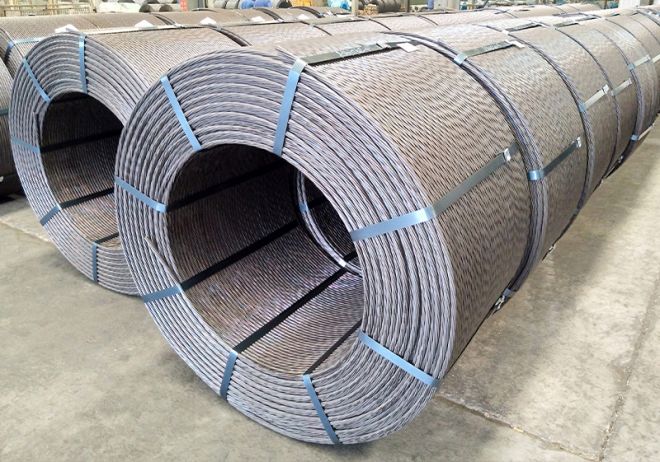
Our standard package uses four main materials plus one label. Each material has one job, and the four work as a single protection chain from the inside out.
Material | Position | Function |
HDPE plastic film | Inner layer | Blocks moisture and outside humidity. It is the first waterproof barrier. |
Non-woven fabric | Outer layer | Resists scraping and tearing, so the film stays intact in transit. |
Steel band | Longitudinal and cross | Holds the coil shape and stops layers from shifting. |
Wooden pallet (10 × 10 cm) | Bottom | Carries the coil off the floor and gives the straps a fixed anchor. |
Label | On the coil | Gives lifting, stacking and transport warnings in advance. |
Table 1 Materials and their role in the package
3 Wooden Pallet: Material, Size and Fixing
A pallet looks like a simple block of wood. In practice it decides three things: whether the bottom of the coil stays dry, whether the coil collapses in transit, and whether the straps can really hold the shape.
3.1 Size and material: 10 by 10 cm, thick and dry
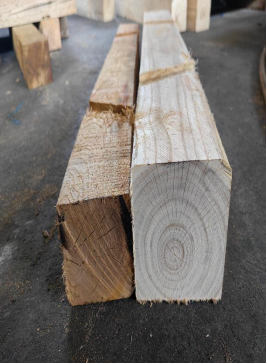
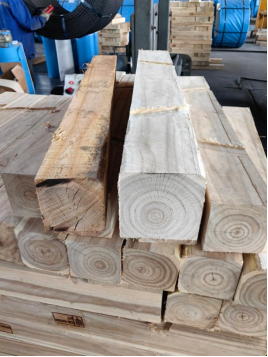
Our pallet measures 10 by 10 cm in section. The bottom of every coil touches both the pallet and the container floor, so this is where water collects and rust starts first. We therefore set two hard rules for the wood: it must be thick enough to carry the load without deforming or splitting, and it must be thoroughly dry.
Wet wood keeps feeding moisture into the coil. This damage is quieter than outside water, and you usually find it only when you open the coil — by then it is too late. This is why we buy dry timber and store it under cover, not just pick whatever is on the yard.
Wood from other suppliers | Our wood |
|
|
Figure 1 Our wood is dry, with no water marks and no damp patches on the surface.
3.2 A larger, stronger pallet
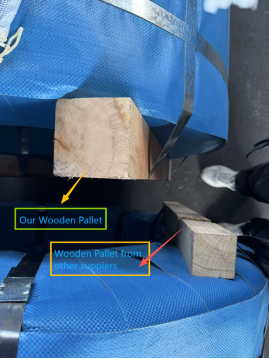
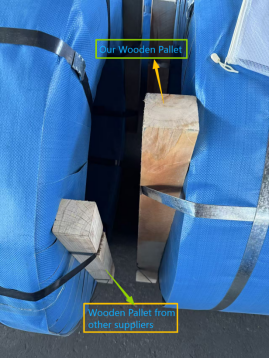
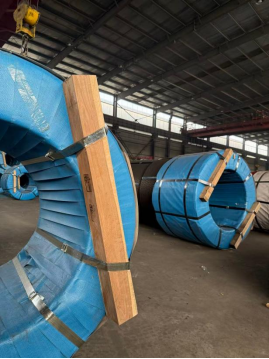
A larger section spreads the load over more area, so the pallet does not split or collapse under stacking and lifting. Our pallet is clearly bigger and stronger than the common size, and it holds up even when coils are stacked on top of each other.
Small pallets are a different story. They lack strength, they break or fall away in transit, and the coil starts to lean once it loses support. The risk only shows up when you unload, which is the worst possible moment.
Pallet size and structure, as labelled |
|
Figure 2 Our pallet is shown at the top; the pallet from other suppliers is shown at the bottom.
3.3 Groove depth: what makes the strap hold
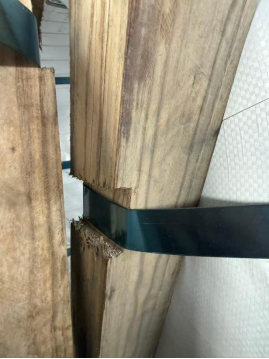
The pallet is also the anchor point for the straps. We cut a deep groove, the strap sits inside it, and it cannot slip off under load. The coil stays locked through the whole journey.
Some suppliers cut a shallow groove, or none at all. The strap then sits on a flat surface and moves as soon as the container starts to shake. The coil loosens from there, layer by layer.
Our pallet groove | Pallet from other suppliers |
|
|
Figure 3 Our groove is deep enough to hold the strap and grip it.
3.4 Flat placement and pre-shipment checks
Pallets sit flat under every coil, with no raised corner and no gap. Before loading we re-tighten each coil and check the pallet, the straps and the label on every one. Nothing is loaded until it passes. The label also carries transport warnings, so handlers know to avoid tilt and impact.
PC Strand Packaging Advantages(Ⅱ)
Causes and Control Measures of Wire Breakage in Prestressed Construction
HOT PRODUCTS

Yuanxian High-tech Material is a company serving a worldwide customers base providing innovative and reliable product solution that recognizes the value of customer care.
+86 180 2006 1362
Haitai Huake Third Road No.1, Huayuan Industrial Zone, Binhai High Tech Zone, Tianjin, china
Quick Links
Product Category

Request a Quote
Welcome to subscribe toour email message!

Send a Message