EN
Price And Market Trend
Oct. 20, 2026
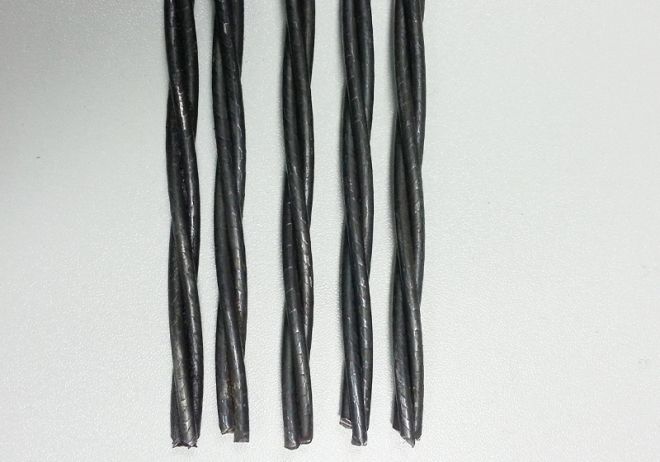
prestressed steel wire is high-strength, low-relaxation steel wire tensioned inside concrete to create compression before service loads act on the structure. Plain, indented, ribbed, galvanized, and coated forms are selected according to bond, corrosion exposure, diameter, strength, and installation method. I use the term to describe individual prestressing wires used in beams, slabs, piles, sleepers, poles, tanks, bridges, and other precast or cast-in-place concrete systems.
Prestressed steel wire is cold-drawn or otherwise processed high-tensile steel with a controlled diameter and surface condition. During construction, the wire is stressed to a specified force, and that force is transferred to the concrete through anchorage, bond, or both. The resulting compressive stress reduces tensile stress in the concrete when the finished member carries its design loads.
In ordinary reinforced concrete, rebar mainly resists tension after concrete cracking begins. Prestressed steel wire introduces force before or during loading, which can control cracking, reduce deflection, increase span capacity, and allow a smaller concrete section for a specified load. The final result depends on wire strength, initial stress, concrete strength at transfer, bond profile, prestress losses, and the quality of installation.
The material is commonly produced from high-carbon steel wire rod through drawing, surface treatment, stress relieving, and inspection. Depending on the project, specifications may reference ASTM A421, ASTM A881, EN 10138, BS 5896, JIS G3536, IS 6006, or GB/T 5224 for related prestressing products. The selected standard should match the structural design code, procurement documents, and acceptance testing plan.
The most important prestressed steel wire properties are tensile strength, proof stress, elongation, ductility, bond performance, relaxation, dimensional accuracy, and corrosion condition. Engineers should review the complete mill certificate rather than selecting material from tensile strength alone. A wire with high strength but unsuitable relaxation, surface profile, or corrosion protection may create unacceptable performance in service.
| Property | Typical engineering range or requirement | Why it matters |
|---|---|---|
| Nominal diameter | Approximately 2.5–8.0 mm for many wire products | Controls steel area, force capacity, spacing, and handling |
| Tensile strength | Commonly 1,570–2,000 MPa, depending on grade | Determines the maximum usable prestressing force |
| Elastic modulus | Approximately 195–205 GPa | Supports elongation and stressing calculations |
| Elongation after fracture | Often about 3.5% or higher, depending on standard | Indicates ductility and deformation capacity |
| Relaxation | Low-relaxation grades may be limited to about 2.5% at specified test conditions | Reduces long-term loss of prestress |
| Diameter tolerance | Often controlled to tenths of a millimeter | Supports accurate steel area, fit, and force calculation |
| Surface condition | Free from harmful rust, cracks, laps, seams, and kinks | Reduces premature failure and bond defects |
Tensile strength and yield behavior determine how much force the wire can carry during stressing and service. Prestressing steel often has no sharply defined yield point, so standards use proof stress or specified residual strain to describe the transition from elastic to permanent deformation. The stressing operation must remain below the approved limit because permanent elongation can prevent accurate force transfer.
Ductility and elongation are equally important. A wire that reaches a high tensile strength but has inadequate elongation may have limited tolerance for local damage, bending, anchorage effects, or handling errors. The required elongation value depends on the governing standard, steel grade, diameter, and testing method, so project documents should state the exact requirement.
Relaxation is the gradual reduction in steel stress while the wire remains elongated. Low-relaxation wire is heat-treated after drawing or stabilization to reduce this loss, but relaxation does not disappear completely. Engineers should also calculate losses caused by concrete creep, concrete shrinkage, anchorage seating, friction in ducts, and elastic shortening.
Bond and surface condition control force transfer. Plain wire may be suitable where mechanical anchorage or a defined bond length is available, while indented or ribbed wire can improve mechanical interlock in pretensioned members. Rust scale, oil, mud, damaged coating, cross-cracks, and deep scratches can reduce bond or create stress concentrations.
The types of prestressed steel wire can be classified by surface profile, coating, diameter, tensile grade, and relaxation behavior. The correct choice depends on whether the wire is used in pretensioning or post-tensioning, how the force enters the concrete, and the environmental exposure of the finished structure.
Plain wire has a relatively smooth surface and a circular cross-section. It is often used with anchorage systems or in applications where the design provides sufficient development length and controlled force transfer. Its simple profile supports consistent drawing and dimensional inspection, but its mechanical bond is lower than that of indented or ribbed wire.
Indented wire has regularly formed depressions that increase mechanical interlock with concrete. This profile is commonly considered for pretensioned beams, slabs, sleepers, and other precast products where direct bond transfer occurs after concrete reaches the required release strength. The indentation geometry must remain within the specified limits because excessive deformation can reduce cross-sectional consistency.
Ribbed and spiral-profile wires use raised surface features to improve bond and resistance to slip. They can be useful when the design requires more reliable force transfer over a short development length. The trade-off is that surface forming adds manufacturing controls, and the producer must verify rib height, pitch, mass, diameter, and tensile performance.
Galvanized wire has a zinc coating intended to improve corrosion resistance during storage, handling, and service. It may be considered for poles, marine-adjacent structures, utility products, and other applications where exposure conditions justify additional protection. The coating must be compatible with the specified bond, anchorage, welding restrictions, and structural design assumptions.
Epoxy-coated and polymer-coated wires provide a barrier against aggressive moisture and chloride exposure. They are appropriate only when the coating system, bending limits, anchorage details, repair procedures, and bond behavior have been evaluated together. Damage to the coating during cutting or stressing must be repaired according to the project specification.
Low-relaxation wire is processed to limit long-term stress reduction under sustained strain. It is selected for members where serviceability, crack control, and long-term prestress retention are important. The purchase specification should identify the relaxation class, test temperature, initial stress percentage, test duration, and acceptance limit rather than using the phrase “low relaxation” without numbers.
Prestressed steel wire works by placing the wire in tension and the concrete in compression. In a pretensioning system, the wire is anchored between end abutments, stressed before concrete casting, and held while the mold is filled. After the concrete reaches its specified transfer strength, the wire is released, and bond transfers part of the stored force into the concrete.
In a post-tensioning system, concrete is cast with ducts or sleeves, and the hardened member reaches the required strength before the wire or tendon is stressed. Anchages at the member ends retain the force after stressing. Duct grouting may then protect the steel and improve composite behavior, while unbonded systems use a protective sheath and rely on end anchorages.
The main sequence is stressing, casting or concrete hardening, force transfer, and inspection. Workers measure both jacking force and elongation because either value alone may fail to identify slippage, incorrect friction, seating loss, or an inaccurate modulus assumption. Any difference outside the project tolerance should be investigated before the system is accepted.
Prestress improves concrete performance by keeping service tensile stress within a controlled range. It can reduce visible cracking, limit deflection, increase span-to-depth ratios, and improve fatigue behavior when the design and materials are properly coordinated. It does not eliminate failure risk; inadequate anchorage, insufficient concrete strength, corrosion, overload, or excessive prestress loss can still cause structural problems.
Prestressed steel wire concrete applications include precast beams, hollow-core slabs, railway sleepers, concrete piles, utility poles, bridge components, tanks, pipes, and specialized infrastructure products. The wire diameter, surface profile, grade, and coating should be selected according to the member geometry and the required transfer length. Factory production is especially suitable because stressing beds, molds, concrete curing, and release operations can be controlled repeatedly.
| Application | Typical wire requirement | Main design benefit |
|---|---|---|
| Precast beams | Indented, ribbed, or plain wire with controlled bond | Higher bending capacity and crack control |
| Prestressed slabs | Small-diameter wire arranged at close spacing | Reduced slab thickness and deflection |
| Railway sleepers | High-strength, fatigue-resistant wire | Repeated-load performance and dimensional stability |
| Concrete piles | Corrosion-controlled wire with reliable transfer | Axial capacity and resistance to handling loads |
| Utility poles | Galvanized or protected wire where exposure requires it | Controlled cracking and durable slender sections |
| Bridge components | Low-relaxation wire or strand systems | Longer spans and reduced service deflection |
| Tanks and pipes | Circumferential or longitudinal prestressing | Crack control under internal pressure |
For bridge construction, prestressing wire or strand allows designers to manage bending moments over longer spans while controlling cracking under traffic and environmental loads. For railway sleepers, repeated dynamic loading makes fatigue resistance, bond, dimensional stability, and production consistency particularly important. For prestressed slabs and beams, small wire diameters can be distributed across the section to provide efficient crack control.
Concrete poles, piles, tanks, and pipes require additional attention to exposure. Chlorides, carbonation, wet-dry cycles, sulfates, and stray electrical currents can increase corrosion risk. A suitable combination of concrete cover, low-permeability concrete, galvanizing or coating, drainage, and inspection is more reliable than relying on the wire coating alone.
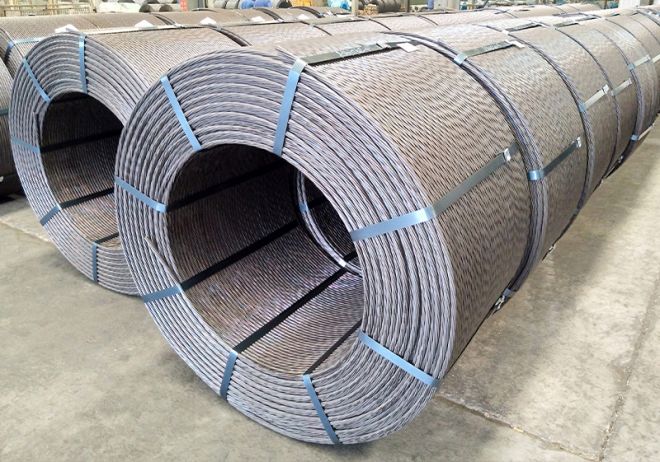
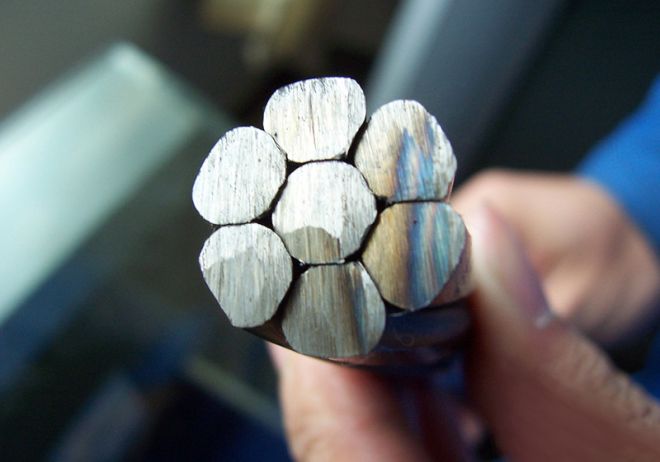
Prestressed steel wire is an individual wire, while PC strand is an assembly of multiple wires twisted around a common axis. A common seven-wire strand uses one central wire and six helically arranged outer wires, while two-wire and three-wire strands are also manufactured for specific products. Strand generally provides higher total force capacity per tendon, whereas individual wire can support closer spacing and more distributed reinforcement in precast members.
Rebar is normally placed without significant initial tension and develops resistance after concrete cracking or deformation. Prestressed steel wire is tensioned deliberately before or during service, making it suitable where crack width, deflection, span, or section size controls the design. Prestressing bars are larger threaded elements used with anchorage and stressing systems that require substantial concentrated force.
| Material | Typical use | Main advantage | Main limitation |
|---|---|---|---|
| Prestressed steel wire | Precast beams, slabs, sleepers, poles | Distributed force and flexible spacing | Requires careful handling and transfer control |
| PC strand | Bridges, girders, slabs, heavy tendons | High tendon force and established anchorage systems | Larger ducts, anchorages, and stressing equipment |
| Reinforcing bar | Conventional reinforced concrete | Simple placement and broad availability | More cracking and deflection under comparable loading |
| Prestressing bar | Heavy post-tensioning and anchorage systems | High concentrated force and threaded connections | Greater weight, cost, and detailing requirements |
I choose wire when the design benefits from distributed prestress, efficient precast production, or relatively small reinforcement spacing. I choose strand when the tendon must carry a larger force through ducts and anchorages. The decision should be based on structural calculations, installation equipment, corrosion exposure, code requirements, and total procurement cost rather than material price per ton alone.
Manufacturing usually begins with controlled high-carbon steel rod, followed by surface preparation and cold drawing through dies. Drawing reduces diameter and increases strength, while stress-relieving or stabilization treatment reduces residual stress and relaxation. Indenting, rib forming, galvanizing, or coating may follow, depending on the product specification.
At receiving inspection, I would verify the heat number, diameter, mass, tensile strength, proof stress, elongation, relaxation class, coating condition, and certificate traceability. Sampling should follow the governing standard and purchase order, with tensile tests performed using calibrated equipment. A practical acceptance record should connect each coil or bundle to its test result and delivery documentation.
Storage is also part of quality control. Wire should remain elevated above standing water, protected from salt spray and chemical contamination, and separated by heat or batch number. Kinks, sharp bends, crushed coils, broken wires, deep scratches, excessive rust, and damaged coatings should be quarantined until an engineer or quality representative approves their disposition.
YUANXIAN supplies prestressing materials and related steel products for international construction and infrastructure markets. Its published product range includes two-wire and three-wire PC strand, seven-wire prestressed strand, low-relaxation grades, and high-tensile products referenced to standards such as ASTM A910, EN 10138, JIS G3536, IS 6006, and GB/T 5224. When evaluating a supplier such as YUANXIAN, I would still match the certificate, test method, dimensions, relaxation class, packaging, and inspection plan to the specific project requirements.
Prestress losses occur in stages rather than at one single moment. Immediate losses may result from anchorage seating, friction, elastic shortening, and wire slip, while long-term losses commonly arise from steel relaxation, concrete creep, and concrete shrinkage. The design calculation should identify each loss separately and apply the correct value for the concrete age, humidity, temperature, stress level, and structural system.
The most serious field risks include corrosion, kinks, surface cracks, incorrect stressing force, inadequate concrete transfer strength, damaged anchorages, poor duct grouting, and unapproved cutting. Inspection should focus on coil condition before installation, wire alignment during placement, concrete strength before release, measured force and elongation during stressing, and visible damage after transfer. These checkpoints reduce the chance that a hidden defect becomes a structural defect.
I recommend choosing prestressed steel wire through a defined sequence of engineering checks. First, identify the structural system and whether the member uses pretensioning or post-tensioning. Next, calculate the required steel area, initial stress, transfer length, service stress, and estimated prestress losses using the applicable design code.
Then compare wire alternatives by diameter, tensile grade, proof stress, elongation, relaxation class, surface profile, coating, corrosion exposure, and available anchorage equipment. Confirm that the selected product can be handled without bending damage and that its required testing can be completed before concrete casting or stressing. Finally, review supplier traceability, packaging, delivery condition, replacement availability, and the cost of inspections and installation.
For small precast projects, a standard indented low-relaxation wire may provide efficient force transfer without the equipment required for larger strand tendons. For bridges and long-span infrastructure, PC strand or prestressing bars may be more appropriate because they support higher tendon forces and established anchorage systems. For chloride or marine exposure, corrosion protection must be coordinated with concrete cover, permeability, drainage, coating repair, and long-term inspection.
Prestressed steel wire is high-strength steel tensioned to introduce compression into concrete before the structure carries its design loads. Its main properties include tensile strength commonly between 1,570 and 2,000 MPa, controlled proof stress, measurable elongation, low relaxation, accurate diameter, reliable bond, and suitable corrosion protection. Plain, indented, ribbed, galvanized, epoxy-coated, and low-relaxation types serve different force-transfer and exposure conditions.
I use prestressed steel wire for beams, slabs, bridge components, railway sleepers, piles, poles, tanks, pipes, and other precast concrete applications when crack control, span capacity, deflection, or section efficiency is important. The final selection should compare wire with PC strand, rebar, and prestressing bars using structural force requirements, installation method, prestress losses, inspection criteria, and total project cost. A complete purchase specification should state the diameter, grade, relaxation class, surface profile, coating, applicable standard, test requirements, and acceptance tolerances.
UF Membrane for Semiconductor Ultrapure Water: Pore Size & Quality Specs
Analysis of Raw Material Price Trends for Prestressed Steel Strand in October
HOT PRODUCTS

Yuanxian High-tech Material is a company serving a worldwide customers base providing innovative and reliable product solution that recognizes the value of customer care.
+86 180 2006 1362
Haitai Huake Third Road No.1, Huayuan Industrial Zone, Binhai High Tech Zone, Tianjin, china
Quick Links
Product Category

Request a Quote
Welcome to subscribe toour email message!

Send a Message